

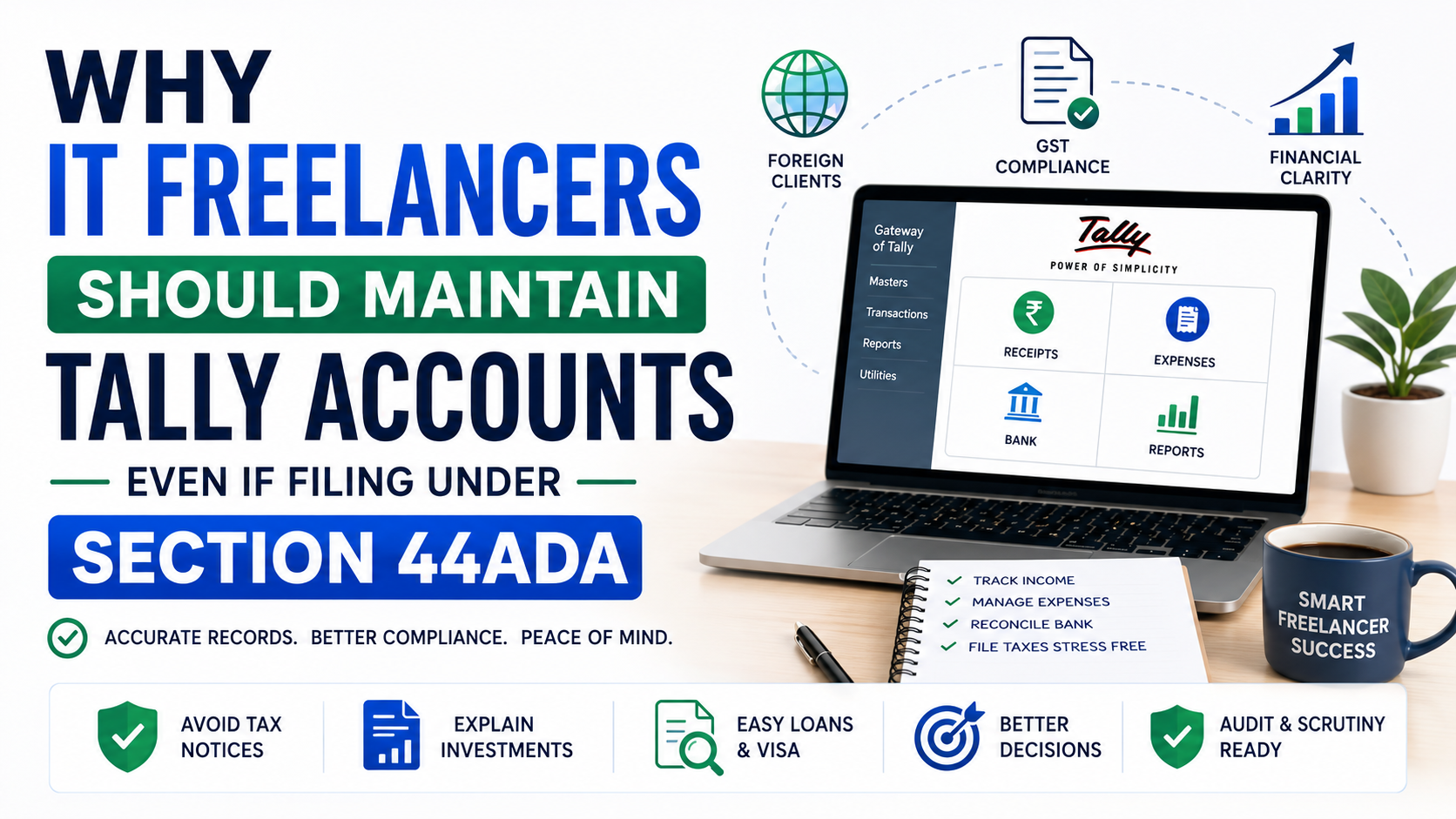
“I am filing under Section 44ADA. Do I really need Tally accounting?”
This is one of the most common questions I receive from IT freelancers, software developers, digital marketers, consultants, AI professionals, and other service providers working with foreign clients.
Most freelancers believe that because they are filing their Income Tax Return under Section 44ADA, they are completely exempt from maintaining books of accounts.
This is only partly true.
While Section 44ADA provides significant compliance relief, it should not be interpreted as a reason to avoid maintaining proper financial records altogether.
As a Chartered Accountant, I strongly recommend that every freelancer maintain proper books of accounts in Tally or any reliable accounting software before filing the Income Tax Return.
Let’s understand why.
What Does Section 44ADA Actually Say?
Section 44ADA provides a presumptive taxation scheme for specified professionals.
Under this scheme, 50% of the gross professional receipts or a higher amount declared by the assessee is deemed to be the taxable professional income, subject to the conditions prescribed under the Income-tax Act.
One major advantage is that eligible professionals are generally not required to maintain the prescribed books of account under Section 44AA if they opt for the presumptive scheme.
However, this does not mean that maintaining proper accounts has no value.
The Biggest Misconception
Many freelancers think:
“My actual profit is around 90%, but the law allows me to show only 50%. Therefore, I don’t need any accounting.”
This approach may appear simple, but it ignores many practical issues that arise during tax compliance.
Your Bank Statement Already Tells a Story
Every payment received from your foreign clients is reflected in your bank statement.
Similarly, every transfer, investment, EMI, mutual fund purchase, fixed deposit, and property payment creates a financial trail.
Although a bank statement is not a complete book of accounts, it provides substantial information about your financial activities.
If your Income Tax Return shows:
- Professional Income: ₹20 lakh
but during the same year you:
- Invest ₹25 lakh in mutual funds
- Purchase a ₹15 lakh car
- Pay ₹8 lakh towards home loan EMI
- Spend heavily on foreign travel
the Income Tax Department may naturally ask:
“What is the source of these funds?”
A properly maintained accounting system helps answer such questions with confidence.
Cash Withdrawal Is Not the Same as Business Expense
Another common practice is:
- Receive ₹40 lakh from clients.
- Withdraw ₹20 lakh in cash.
- Declare only 50% income under Section 44ADA.
Many freelancers assume that once the money is withdrawn in cash, there is no need to explain its utilisation.
This assumption can be risky.
A cash withdrawal merely proves that money left the bank account.
It does not prove that the money was actually spent for business purposes.
The cash may have been:
- Business expenditure
- Personal expenditure
- Savings kept at home
- Investment elsewhere
- Loan to relatives
- Gift
- Any other utilisation
Without proper accounting, it becomes difficult to explain the complete financial picture whenever required.
Proper Books Help Explain Your Financial Capacity
Suppose your accounting records show:
- Professional Receipts
- Business Expenses
- Capital Introduced
- Personal Drawings
- Investments
- Fixed Assets
- Bank Reconciliation
Now your financial story becomes complete.
Even if the department seeks clarification, you have proper records to support your explanations.
GST Compliance Is Much Easier
Most IT freelancers serving foreign clients are also registered under GST.
Maintaining proper books in Tally helps reconcile:
- Export invoices
- GST turnover
- GSTR-1
- GSTR-3B
- Foreign remittances
- Bank receipts
Without accounting, these reconciliations are usually prepared manually at the last minute, increasing the chances of mistakes.
Foreign Remittance Reconciliation
Professional accounting helps reconcile:
- Invoice Number
- Invoice Date
- Client Name
- Currency
- Exchange Rate
- INR Value
- Date of Receipt
- Bank Credit
This becomes extremely useful during GST verification or while preparing annual returns.
AIS and Annual Information Statement
Today, the Income-tax Department receives financial information from multiple reporting sources.
Examples include:
- Bank transactions
- Mutual fund investments
- Securities transactions
- Property purchases
- Foreign remittances
- Credit card reporting
- High-value financial transactions
Your accounting records should be capable of explaining these transactions whenever necessary.
Better Financial Planning
Most freelancers focus only on tax saving.
However, accounting provides much greater benefits.
It helps answer questions such as:
- What is my actual profit?
- Which client is most profitable?
- How much GST have I collected?
- What are my monthly business expenses?
- What amount should I invest?
- How much advance tax should I pay?
- Can I afford to hire employees?
Without proper books, these answers are usually based on guesswork.
Easier Loan Approval
Banks frequently ask for:
- Financial Statements
- Income Tax Returns
- Business Performance
- Cash Flow
Freelancers having proper accounting records generally find it easier to obtain:
- Home Loans
- Business Loans
- Vehicle Loans
- Overdraft Facilities
Proper accounting improves financial credibility.
Easier Visa Applications
Many countries ask self-employed professionals to furnish:
- Income Proof
- Financial Statements
- Business Income Details
- Source of Funds
Proper books maintained in Tally make this process much smoother.
Better Business Decisions
Accounting tells you:
- Which clients pay on time.
- Which services generate higher margins.
- Outstanding receivables.
- Currency gains or losses.
- Subscription costs.
- Software expenses.
- Business profitability.
These insights cannot be obtained merely from a bank statement.
Preparation for Future Growth
Many freelancers eventually:
- Form LLPs
- Incorporate Private Limited Companies
- Raise investments
- Employ staff
- Expand internationally
Proper accounting from the beginning makes this transition much easier.
Professional Representation During Scrutiny
If your case is selected for scrutiny or verification, a Chartered Accountant can represent you much more effectively when proper books are available.
Well-maintained records create confidence and significantly reduce the time required to respond to notices.
What Should Every Freelancer Maintain?
At a minimum, every freelancer should maintain:
- Client-wise invoices
- Bank entries
- Expense vouchers
- Foreign remittance details
- GST reconciliation
- TDS details
- Fixed asset register
- Capital account
- Investment register
- Personal drawings
- Income Tax workings
All these can be maintained efficiently in Tally.
Should You Always Declare Only 50% Under Section 44ADA?
Section 44ADA permits eligible professionals to declare 50% of the gross receipts or a higher amount as presumptive income.
However, tax planning should not be based solely on the statutory minimum.
Your declared income should also be viewed alongside your overall financial profile, including:
- Investments
- Lifestyle
- Asset purchases
- Household expenditure
- Loans
- Savings
- Capital formation
If these appear inconsistent with the income disclosed in the return and no satisfactory explanation exists from other legitimate sources, you may receive queries from the tax authorities. Proper accounting helps explain the movement of funds and strengthens your overall compliance.
Why Get Your Accounts Prepared by a Chartered Accountant?
A Chartered Accountant does much more than enter transactions into Tally.
A CA can help you:
- Classify business and personal transactions correctly.
- Reconcile GST turnover with Income Tax turnover.
- Match invoices with foreign remittances.
- Identify missing receipts.
- Verify TDS credits.
- Review AIS and Form 26AS.
- Compute capital gains, if any.
- Plan advance tax.
- Identify compliance gaps before filing the return.
- Maintain records that are useful if a notice is received.
The objective is not merely to file the Income Tax Return—it is to file a return that is accurate, consistent, and supported by proper documentation.
Conclusion
Section 44ADA was introduced to simplify taxation for professionals—not to discourage good accounting practices.
Maintaining books of accounts in Tally is not just about complying with the law. It is about understanding your business, improving financial decision-making, supporting GST compliance, reconciling foreign receipts, and ensuring that your overall financial affairs remain consistent and well documented.
Whether you ultimately declare 50% or a higher amount under Section 44ADA, professionally maintained books provide clarity, confidence, and peace of mind. In today’s data-driven tax environment, good accounting is an investment in the long-term health of your freelance practice.
Frequently Asked Questions (FAQs)
1. Is maintaining books of account compulsory under Section 44ADA?
Eligible professionals opting for Section 44ADA are generally not required to maintain the prescribed books under Section 44AA. However, maintaining proper accounting records is a recommended best practice.
2. Can I maintain my accounts even if the law does not require it?
Yes. Many professionals voluntarily maintain books because they assist in GST compliance, financial planning, loan applications, and responding to tax queries.
3. Is a bank statement a substitute for accounting?
No. A bank statement records money moving in and out of the bank. It does not classify transactions into income, expenses, capital, investments, assets, liabilities, or drawings.
4. Why should a Chartered Accountant prepare my Tally books?
A CA ensures correct accounting treatment, reconciles GST and tax records, reviews compliance issues, and prepares reliable financial information that supports your Income Tax Return.
5. Will maintaining books affect my eligibility under Section 44ADA?
No. Voluntarily maintaining books does not, by itself, take away the benefit of Section 44ADA, provided you otherwise satisfy the legal conditions of the section.
Disclaimer: This article is intended for educational purposes only and does not constitute legal or tax advice. Tax positions depend on the facts of each case and applicable law. Readers should consult a Chartered Accountant or tax professional before making compliance decisions.


0 responses on "Why IT Freelancers Should Maintain Proper Books of Accounts Even When Filing Under Section 44ADA"