

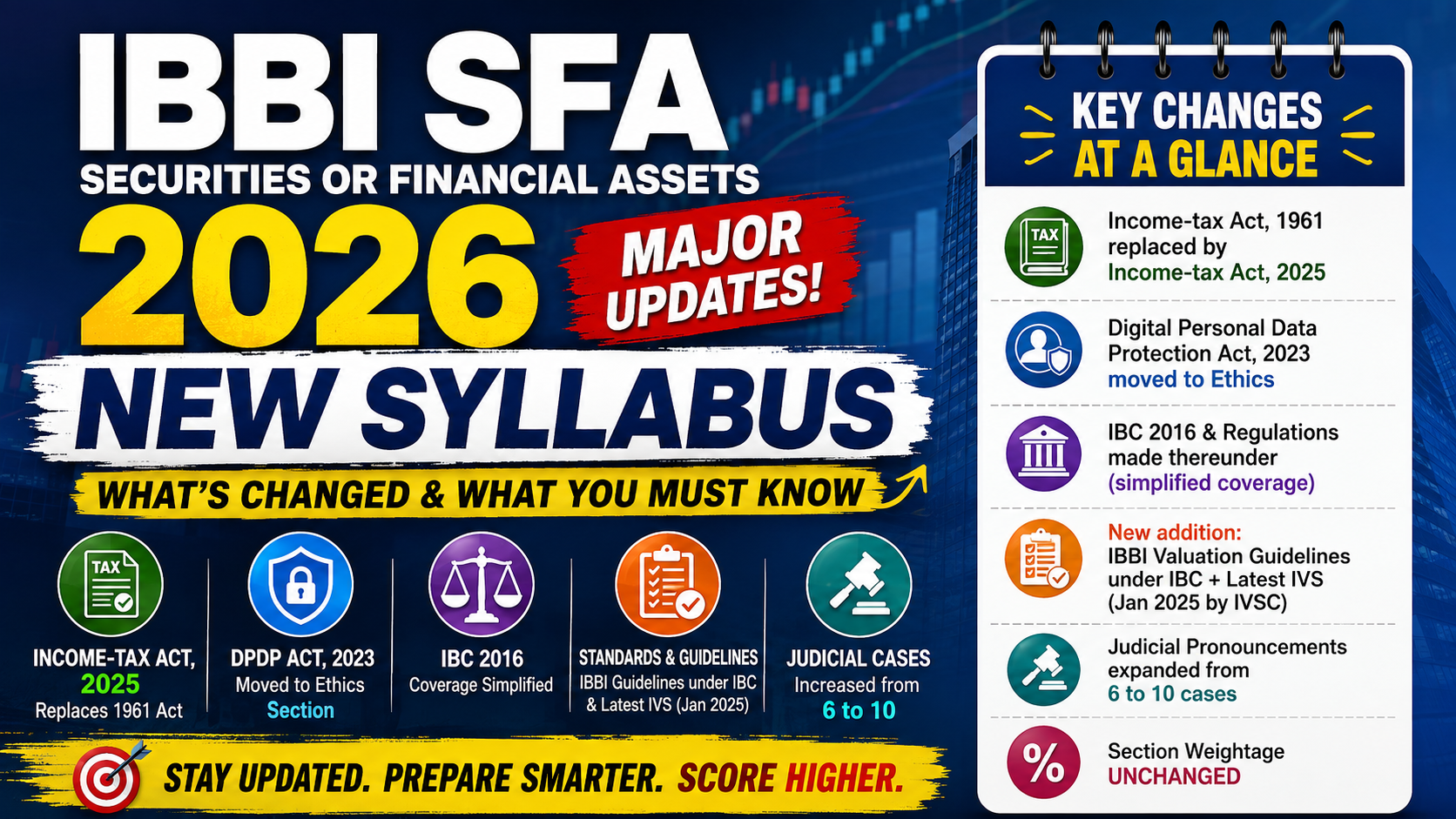
IBBI SFA New Syllabus 2026: What Has Changed and What Students Need to Know
The IBBI Securities or Financial Assets (SFA) syllabus has been updated for 2026, bringing several important changes while keeping most of the core valuation curriculum intact.
For students preparing for the IBBI Valuation Examination, the good news is that the overall structure and weightage remain largely unchanged. However, there are a few significant updates that deserve focused attention—particularly the Income-tax Act, 2025, valuation standards and guidelines, the Digital Personal Data Protection Act, and additional judicial precedents.
The revised syllabus is effective from 21 August 2026, with the updated legal position notified as on 30 June 2026.
1. The Biggest Change: Income-tax Act, 2025 Replaces the 1961 Act
One of the most important changes is in the General Laws section.
The Income-tax Act, 1961 has been replaced in the syllabus by the Income-tax Act, 2025. Earlier, the syllabus specifically referred to Rule 11UA of the Income-tax Rules in connection with valuation.
Under the revised syllabus, this specific reference has been removed and replaced with the broader concept of “Valuation under Income-tax Act.”
What does this mean for students?
Students preparing from older study material should not continue relying exclusively on references to the Income-tax Act, 1961. The relevant provisions and terminology need to be updated according to the Income-tax Act, 2025.
This is not merely a cosmetic change. Since valuation provisions can be closely linked to taxation law, candidates should pay particular attention to the applicable provisions under the new legislation.
2. Digital Personal Data Protection Act Moved to Ethics
The Digital Personal Data Protection Act, 2023 (DPDP Act) has not been removed from the syllabus.
Instead, its location has changed.
Earlier, it appeared under Section 4 – General Laws. In the 2026 syllabus, it has been moved to Section 3 – Professional/Business Ethics and Standards.
This is therefore primarily a relocation and positioning change, although the subject itself remains examinable.
Why is this relevant?
The relocation reflects the growing importance of data protection, confidentiality and responsible handling of information in professional practice.
For students, the practical takeaway is simple:
Do not skip the DPDP Act just because it has disappeared from General Laws. It has been shifted to the Ethics section.
3. IBC 2016 Coverage Has Been Simplified
The Insolvency and Bankruptcy Code, 2016 continues to form part of the syllabus.
However, the 2026 syllabus has simplified the earlier detailed listing.
The 2024 syllabus separately mentioned areas such as:
- Part I – Preliminary
- Part II – Corporate Insolvency Resolution and Liquidation
- CIRP Regulations, 2016
- Liquidation Process Regulations, 2016
- Voluntary Liquidation Process Regulations, 2017
- Valuation under IBC
The 2026 syllabus instead uses a more general formulation covering the IBC, 2016 and the Regulations made thereunder.
This appears to be a condensation of the syllabus language rather than removal of the subject.
Students should therefore avoid interpreting the shorter wording as meaning that IBC-related valuation concepts are no longer relevant.
4. A Major New Addition: Standards and Guidelines
Perhaps the most important academic addition is the new “Standards and Guidelines” subsection under Section 8 – Valuation Application.
The revised syllabus specifically brings in:
- IBBI Guidelines for Conducting Valuation under IBC
- Requirements relating to valuation documentation and minimum report content
- Relevant parameters and formats for valuation reports
- The role of coordinating valuers
- The latest International Valuation Standards (IVS), as updated in January 2025 by the International Valuation Standards Council (IVSC)
This is a significant development because valuation standards and professional guidance are now explicitly examinable rather than being merely implicit within the broader valuation curriculum.
How should students prepare?
This portion deserves dedicated preparation.
Candidates should understand not only the names of the standards and guidelines but also their purpose, applicability, reporting requirements and practical relevance to valuation assignments.
The new addition also reinforces an important theme of the revised syllabus: an increasing emphasis on professional valuation practice, rather than valuation theory alone.
5. Judicial Pronouncements Increased from 6 to 10 Cases
The Judicial Pronouncements on Valuation section has also been expanded.
The 2024 syllabus contained 6 cases. The 2026 syllabus retains those cases and adds 4 new judicial precedents, taking the total to 10 cases.
The newly added cases include:
- Tata Consultancy Services Ltd. v. Cyrus Investments Pvt. Ltd. & Ors.
- Daiichi Sankyo Company Ltd. v. Jayaram Chigurupati & Ors.
- Hindustan Lever Ltd. v. State of Maharashtra
- Cadbury India Ltd. v. Samant Group
This is an important exam-oriented change because judicial precedents are now given a broader coverage within the valuation syllabus.
Students should prepare these cases systematically, focusing on:
Facts → Issue → Decision → Valuation relevance → Key principle
Simply memorising case names may not be sufficient for effective preparation.
6. Standalone “Valuation Standards” Reference Removed from Section 6
The earlier syllabus contained a separate reference to “Valuation standards” under the Overview of Valuation section.
This standalone reference has been removed in the revised syllabus.
However, this should not be interpreted as removal of valuation standards from the examination.
Instead, the subject has been moved and expanded under the new Standards and Guidelines subsection in Section 8.
In other words:
2024: Valuation standards mentioned briefly under Overview
2026: Valuation standards and guidelines addressed more specifically under Valuation Application
This is better viewed as a relocation and expansion, rather than a deletion.
7. The Core Valuation Topics Remain Unchanged
A major positive for existing students is that most of the core technical syllabus remains the same.
There is no substantive change to areas such as:
- Macroeconomics
- Time value of money
- Investment, financing and dividend decisions
- Financial statement analysis
- Ind AS-related valuation topics
- Cost approach
- Market approach
- Income approach
- Equity valuation
- Business strategy analysis
- Business combinations
- Cost of capital
- Fixed income securities
- Intangible assets
- Situation-specific valuation
- Case studies
Therefore, students who have already prepared the core valuation concepts do not need to start from scratch.
The strategy should instead be to update the changed portions while retaining strong command over the existing technical syllabus.
8. Section Weightages Remain Unchanged
Another important point is that the overall section weightages have not changed.
The broad distribution remains:
| Section | Weightage |
|---|---|
| Macroeconomics | 3% |
| Finance & Financial Statement Analysis | 6% |
| Professional/Business Ethics & Standards | 3% |
| General Laws | 18% |
| Financial Reporting / Ind AS | 3% |
| Overview of Valuation | 4% |
| Valuation Approaches | 3% |
| Valuation Application | Within the valuation component |
| Judicial Pronouncements | 1% |
| Case Studies | 26% |
The syllabus therefore remains heavily oriented towards valuation application and case-based understanding, rather than becoming a completely law-heavy examination.
9. The Cut-off Date Has Been Updated
The applicability cut-off has also moved forward.
Earlier:
Updated as on 31 December 2023
Revised:
Notified as on 30 June 2026
This is important because students using older books, notes, question banks or recorded lectures may encounter references based on the earlier cut-off date.
For legal and regulatory portions, candidates should ensure that their preparation material reflects the 2026 cut-off position.
What Does the New Syllabus Mean for Students?
The 2026 syllabus is best understood as an update rather than a complete overhaul.
The majority of the technical valuation content remains unchanged. The significant additions and modifications are concentrated in four areas:
1. Updated law
The Income-tax Act, 2025 replaces the Income-tax Act, 1961 in the syllabus.
2. Updated professional standards
IBBI valuation guidelines and the latest IVS have been expressly incorporated.
3. Updated case law
Judicial pronouncements have increased from 6 to 10 cases.
4. Repositioned legislation
The DPDP Act has moved from General Laws to Professional/Business Ethics and Standards.
How Should You Prepare for the 2026 Syllabus?
A smart preparation strategy would be to divide the syllabus into “unchanged” and “updated” portions.
Step 1: Do not restart your entire preparation
If you have already prepared the 2024 syllabus, most of your technical preparation remains useful.
Continue revising:
- Valuation approaches
- Financial analysis
- Financial assets
- Fixed income securities
- Intangible assets
- Business valuation
- Case studies
Step 2: Create a separate “2026 Updates” notebook
Keep a dedicated section for:
- Income-tax Act, 2025
- DPDP Act
- IBC updates/relevant regulations
- IBBI valuation guidelines
- IVS 2025
- Four newly added judicial precedents
- Updated legal cut-off date
This will make final revision significantly easier.
Step 3: Give special attention to Section 8
The new Standards and Guidelines portion is one of the clearest areas of fresh preparation.
Candidates should understand the practical framework of valuation reports, documentation, prescribed parameters and professional standards.
Step 4: Prepare all 10 judicial cases
Do not study only the four new cases.
The 2026 syllabus retains the original six cases and adds four new ones. Therefore, the complete list of ten cases should be covered.
Step 5: Update your study material
One of the biggest risks for students is relying on older notes without checking the legal changes.
Particularly for General Laws, old references to the Income-tax Act, 1961 should be reviewed carefully.
Final Takeaway
The IBBI SFA 2026 syllabus is an evolutionary update, not a complete transformation.
The core valuation concepts remain substantially intact, and the section weightages are unchanged. The real focus of the revision is on bringing the syllabus in line with the latest legal framework, professional valuation standards and contemporary judicial developments.
The four changes students should remember most clearly are:
Income-tax Act, 1961 → Income-tax Act, 2025
DPDP Act → moved from General Laws to Ethics
Valuation Standards → expanded under Section 8
Judicial Pronouncements → 6 cases increased to 10
For students who have already prepared the earlier syllabus, this is encouraging news. The right approach is not to abandon existing preparation, but to systematically identify, update and master the new portions.
Ultimately, success in the 2026 IBBI SFA examination will depend less on memorising the fact that the syllabus has changed and more on understanding how the new legal provisions, valuation standards and case law connect with practical valuation assignments.


0 responses on "IBBI SFA 2026 New Syllabus: Key Changes, Updates & Exam Preparation Guide"