

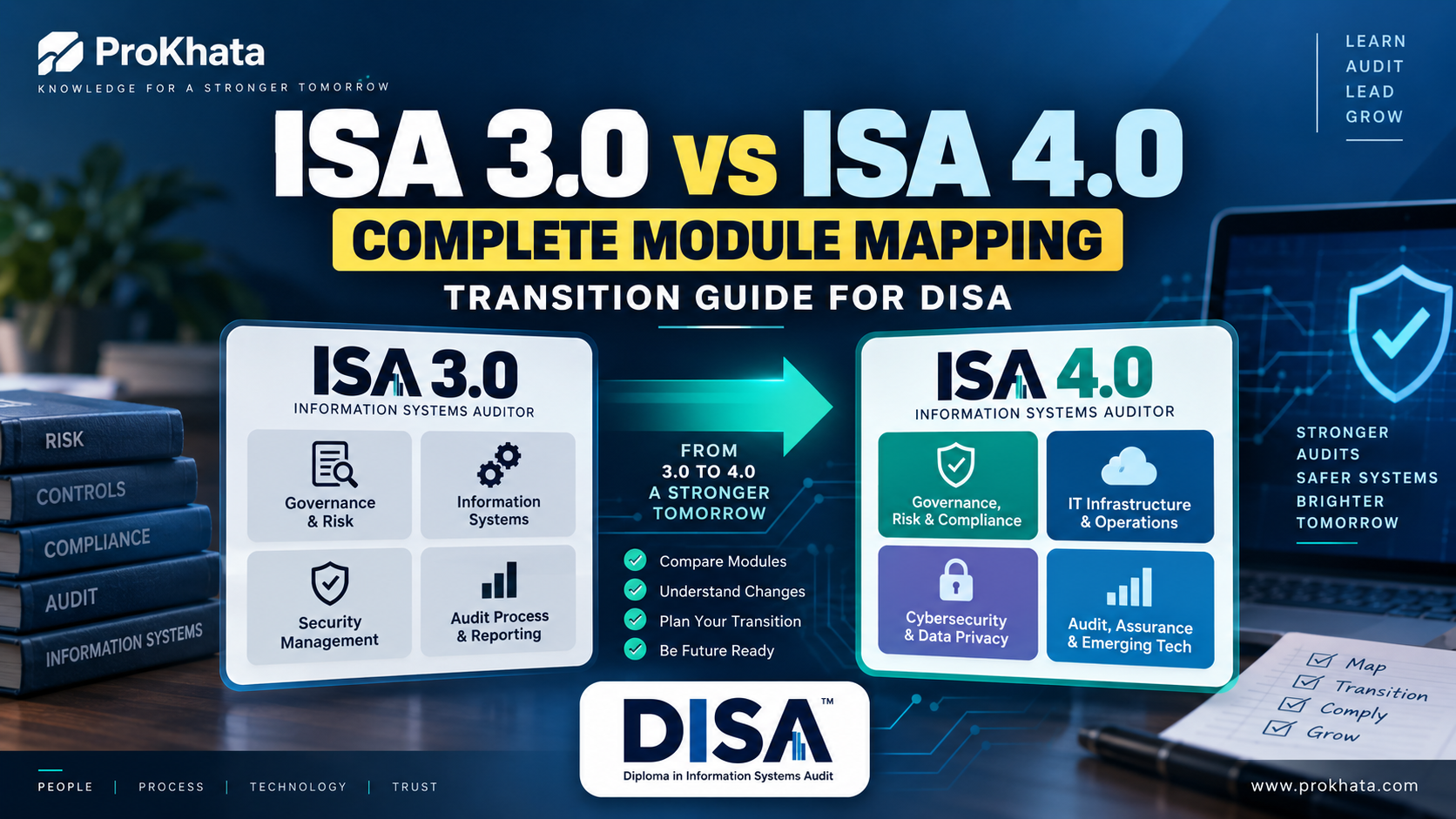
If you qualified as a DISA holder under the ISA 3.0 regime, or if you’re currently studying from ISA 3.0 background material, the launch of ISA 4.0 by ICAI’s Digital Accounting and Assurance Board (DAAB) may feel disorienting. Has everything you learned become obsolete? Do you need to start from scratch?
The short answer is no. ISA 4.0 does not discard ISA 3.0’s theoretical foundations. Instead, it reorganises, modernises, and expands the knowledge into eight operational audit streams that mirror how IS audits are actually conducted in real-world engagements today. Every ISA 3.0 concept has a home inside ISA 4.0 — and this guide will show you exactly where.
Important Disclaimer: This mapping is an educational content synthesis designed to help candidates bridge concepts between the two frameworks. It is not an official ICAI statutory decree. Always verify the latest curriculum announcements directly on the DAAB portal.
ISA 3.0 at a Glance: The Six Foundation Modules
The ISA 3.0 curriculum, published by DAAB as the foundational background material for the DISA qualification, organized Information Systems Auditing knowledge into six academic modules. These modules followed a theory-first, domain-based approach:
Audit charter, planning, risk assessment, evidence gathering, CAATs, and professional reporting standards.
IT steering committees, COBIT governance, strategic alignment, risk treatment, regulatory compliance, business continuity.
SDLC lifecycle, project management, vendor package acquisition, input/processing/output controls, post-implementation reviews.
Data center operations, job scheduling, incident management, hardware maintenance, backup routines, service management.
Logical & physical security, encryption, identity & access management, firewalls, network protocols, cryptographic keys.
Cloud computing, virtualization, IoT, artificial intelligence, blockchain, digital payment security.
ISA 4.0 at a Glance: The Eight Operational Audit Modules
ISA 4.0 fundamentally shifts the organizing principle from academic domains to operational audit streams. Each module now mirrors a type of IS audit engagement that practitioners encounter in real-world assignments. ICAI expanded from six to eight modules, carving out dedicated coverage for identity management, technical security testing, application security, and business resilience:
Automated business rules in ERP systems, input validation, 3-way matching, output reconciliation, audit trails.
User lifecycle, change management, database security, backup schedules, batch jobs, system logging, RCM testing.
Vendor risk assessments, cloud SLAs, SOC 1/SOC 2 reports, right-to-audit clauses, fourth-party supply chains.
PAM vaults, MFA/SSO, JML lifecycle, Segregation of Duties, dormant accounts, zero trust architecture.
COBIT/ISO 27001 frameworks, IT risk appetite, Board dashboards, DPDP Act compliance, steering committee reviews.
Vulnerability assessments, penetration testing, CVSS scoring, firewall rule reviews, patch verification, remediation retesting.
OWASP Top 10, SAST/DAST scanning, Secure SDLC, DevSecOps pipelines, API endpoint protection, code review.
BIA, RTO/RPO metrics, disaster recovery drills, immutable backups, ransomware playbooks, SOC/SIEM escalation.
Key Structural Changes: What Moved, What’s New
The transition from six modules to eight was not simply about adding two extra chapters. ICAI fundamentally reorganised the knowledge architecture. Here are the most significant structural shifts:
1. Topics That Were Elevated to Standalone Modules
Several topics that existed as subsections within ISA 3.0 modules were promoted to full, dedicated modules in ISA 4.0, reflecting their growing importance in modern audits:
- Identity & Access — was a subsection in Module 5
- VA/PT concepts — scattered across Module 5
- OWASP/Secure coding — brief mention in Module 3
- BCM/DR — subsection in Module 2
- Module 4 — dedicated IAM & Access Controls
- Module 6 — dedicated VA/PT Audits
- Module 7 — dedicated Application Security
- Module 8 — dedicated Business Resilience
2. Topics That Were Merged or Reorganised
Some ISA 3.0 content that was spread across multiple modules has been consolidated under a single ISA 4.0 module for coherence:
Example: ISA 3.0’s data center operations (Module 4) and audit process controls (Module 1) — both dealt with change management, user provisioning, and backup verification. In ISA 4.0, these are unified under Module 2 (ITGC), creating a single, comprehensive ITGC audit framework instead of scattering related controls across different academic domains.
3. Entirely New Content Added in ISA 4.0
ISA 4.0 introduces several topics that had no presence or only minimal mention in ISA 3.0:
- Zero Trust Architecture — an IAM paradigm that ISA 3.0 predates entirely (Module 4)
- DevSecOps & CI/CD pipeline security — modern software delivery practices (Module 7)
- SOC 1/SOC 2 Type II report evaluation — structured third-party assurance (Module 3)
- Ransomware response playbooks & SOC/SIEM — cyber crisis management (Module 8)
- DPDP Act compliance — India’s new digital personal data protection statute (Module 5)
- CVSS v3/v4 scoring frameworks — standardised vulnerability severity (Module 6)
- Fourth-party vendor risk — auditing your vendor’s vendors (Module 3)
- Immutable (WORM) cloud backup strategies — ransomware-proof recovery (Module 8)
The Big Picture: 6 Modules → 8 Modules
At the highest level, the transition can be visualised as a reorganisation from a theory-driven academic structure to a practice-driven audit engagement structure:
Core Principle: ISA 3.0 asked “What knowledge domain does this belong to?” (e.g., “Protection of Information Assets”). ISA 4.0 asks “What type of audit engagement would use this?” (e.g., “Identity Management & Access Controls Audit”). Same knowledge, different organising lens.
Master Mapping: ISA 4.0 Module → ISA 3.0 Sources
The table below is the definitive cross-reference. For each ISA 4.0 module, it shows which ISA 3.0 module(s) contributed the underlying content and how the material was transformed:
| ISA 4.0 Module | Focus Area | ISA 3.0 Source(s) | Transformation | Status |
|---|---|---|---|---|
| Mod 1 | Application Control Audits | M3 (Sec 2) + M1 (Specialised Systems) | Basic input/process/output controls evolved into automated ERP business rule audits, 3-way matching, and intelligent audit trail analytics. | |
| Mod 2 | IT General Controls (ITGC) | M1 (Audit Process) + M4 (IS Operations) | Day-to-day operations and change management procedures unified into a structured Risk Control Matrix (RCM) framework for SOX/ICFR audits. | Merged |
| Mod 3 | Third-Party & Outsourcing | M2 (Sourcing) + M6 (Cloud) | Simple vendor contract reviews expanded to cloud shared-responsibility models, SOC report evaluation, and fourth-party supply chain risks. | |
| Mod 4 | Identity & Access Controls | M5 (Logical Access) + M4 (Operations) | Password policies elevated to enterprise IAM, zero trust, PAM vaults, MFA enforcement, and automated JML lifecycle management. | New Module |
| Mod 5 | IT Governance, Risk & Compliance | M2 (Governance, Risk, Compliance) | Theoretical COBIT/ISO models bridged with practical IT risk appetite dashboards and modern DPDP Act privacy compliance. | |
| Mod 6 | Technical Security & VA/PT | M5 (Network Security) + M1 (CAATs) | Passive security reviews transformed into active VA/PT commissioning, CVSS scoring, firewall audits, and remediation verification. | New Module |
| Mod 7 | Application Security Audit | M3 (SDLC) + M5 (InfoSec) | Traditional waterfall SDLC auditing evolved into DevSecOps, OWASP Top 10, SAST/DAST scanning, and API endpoint protection. | New Module |
| Mod 8 | Business Resilience & BCM | M2 (BCM) + M4 (Incident Mgmt) | Conventional tape-backup DR expanded into cyber crisis response, ransomware playbooks, SOC/SIEM escalation, and immutable cloud failover. | New Module |
Deep-Dive: Module-by-Module Mapping
Let’s walk through each ISA 4.0 module and trace exactly what came from ISA 3.0 and what’s genuinely new.
Application Control Audits
From ISA 3.0 M3: The foundational input validation controls, processing logic checks, and output reconciliation concepts. ISA 3.0 taught these as textbook categories — ISA 4.0 now frames them around live ERP systems like SAP, Oracle, and Finacle where the auditor examines actual system configuration rules.
From ISA 3.0 M1: The audit evidence and testing methodology sections (how to reperform controls, what constitutes sufficient audit evidence) now feed directly into the testing approach for application controls.
What’s new in 4.0: Automated 3-way match validation (PO vs GRN vs Invoice), ERP tolerance threshold configuration audits, intelligent audit trail analytics, and interface control testing between interconnected systems.
IT General Controls (ITGC) Audit
From ISA 3.0 M1: The audit process framework (planning, fieldwork, reporting) now provides the methodological backbone for ITGC testing using Risk Control Matrices (RCMs) — the primary working paper in statutory and SOX/ICFR audits.
From ISA 3.0 M4: Data center operations, job scheduling, backup routines, and incident management content has been reframed as specific ITGC control categories that auditors test against.
What’s new in 4.0: Structured RCM methodology, formal change management ticket audit trails (Jira/ServiceNow), UAT sign-off verification, production deployment segregation, and database parameter file reviews.
Third-Party & Outsourcing Audits
From ISA 3.0 M2: Basic outsourcing governance and vendor contract review concepts — ISA 3.0 treated vendor risk as a subsection of IT governance.
From ISA 3.0 M6: Cloud computing concepts (IaaS, PaaS, SaaS) now serve as the technological context for understanding shared-responsibility models and cloud service provider risk assessment.
What’s new in 4.0: SOC 1/SOC 2 Type II report evaluation methodology, right-to-audit contractual clauses, fourth-party vendor risk (your vendor’s subcontractors), cloud exit strategy planning, and SLA penalty enforcement mechanisms.
Identity Management & Access Controls New Standalone Module
From ISA 3.0 M5: The logical access control section (passwords, user roles, authentication mechanisms) has been extracted and massively expanded into a full module.
From ISA 3.0 M4: User provisioning and deprovisioning operations content (onboarding/offboarding procedures) was pulled from operations management into IAM.
What’s new in 4.0: Zero Trust Architecture, Privileged Access Management (PAM) vaults, Multi-Factor Authentication (MFA) policy audits, Joiner-Mover-Leaver (JML) lifecycle automation, Segregation of Duties (SoD) conflict matrix analysis, dormant account discovery, and SSO federation reviews.
IT Governance, Risk & Compliance (GRC)
From ISA 3.0 M2: This is the most direct 1:1 mapping. The governance, risk management, and compliance sections of ISA 3.0 Module 2 directly feed ISA 4.0 Module 5. COBIT, ISO 27001, ISO 31000, IT steering committee oversight, and strategic alignment concepts are carried forward.
What’s new in 4.0: DPDP Act (Digital Personal Data Protection) compliance auditing, practical IT risk appetite quantification, Board-level IT dashboard reviews, and integration of ESG (Environmental, Social, Governance) considerations into IT governance.
Technical Security Testing & VA/PT Audits New Standalone Module
From ISA 3.0 M5: Network security, firewall architecture, and IDS/IPS concepts provided the theoretical foundation.
From ISA 3.0 M1: CAATs (Computer Assisted Audit Techniques) and tools-based audit methodology provide the procedural framework for commissioning and interpreting technical tests.
What’s new in 4.0: Complete VA/PT audit lifecycle — from scoping rules of engagement to commissioning third-party testers, interpreting CVSS v3/v4 severity scores, validating remediation, and conducting retesting. This is entirely new operational content that ISA 3.0 never covered in actionable depth.
Application Security Audit New Standalone Module
From ISA 3.0 M3: The SDLC (Software Development Life Cycle) section, including waterfall/agile development phases, testing methodologies, and post-implementation reviews.
From ISA 3.0 M5: Information security concepts applied to software (application-layer encryption, secure authentication within applications).
What’s new in 4.0: OWASP Top 10 vulnerability categories (SQL injection, XSS, broken access control), SAST/DAST automated code scanning tools, Secure SDLC (SSDLC) frameworks, DevSecOps pipeline integration, API security auditing, container security, and code repository access controls.
Business Resilience & Cyber Crisis / BCM New Standalone Module
From ISA 3.0 M2: Business Continuity Management (BCM) was covered as a subsection within IT governance. The basic concepts of BIA, RTO, and RPO originated here.
From ISA 3.0 M4: Incident management procedures and backup restoration concepts from IS operations.
What’s new in 4.0: Ransomware-specific response playbooks, Security Operations Centre (SOC) and SIEM integration, immutable (WORM) backup strategies, air-gapped recovery architectures, automated multi-region cloud failover testing, and cyber insurance coverage auditing.
Reverse Mapping: Where Did Each ISA 3.0 Module Go?
If you’re coming from ISA 3.0 and wondering “where did my Module X content end up?”, this reverse-lookup table provides the answer:
| ISA 3.0 Module | Original Topic | Now Lives In (ISA 4.0) | What Happened |
|---|---|---|---|
| M1 | IS Audit Process | Mod 2 (ITGC methodology) + Mod 1 (evidence gathering for app controls) + Mod 6 (CAATs → VA/PT tools) | Audit process methodology is now embedded within each ISA 4.0 module rather than being a separate academic chapter. |
| M2 | Governance, Risk, Compliance & BCM | Mod 5 (GRC) + Mod 3 (outsourcing governance) + Mod 8 (BCM extracted) | Split into three focused modules. GRC retained in Mod 5; vendor governance moved to Mod 3; BCM elevated to standalone Mod 8. |
| M3 | SDLC, Acquisition & Application Controls | Mod 1 (application controls) + Mod 7 (SDLC → application security) | Controls vs security distinction created. Business logic controls → Mod 1; code-level security → Mod 7. |
| M4 | IS Operations & Management | Mod 2 (ITGC — operations become control categories) + Mod 4 (user provisioning → IAM) + Mod 8 (incident mgmt → BCM) | Distributed across three modules based on audit engagement type. |
| M5 | Protection of Information Assets | Mod 4 (logical access → IAM) + Mod 6 (network security → VA/PT) + Mod 7 (app security) | The largest disaggregation. ISA 3.0’s broadest module was split into three specialised ISA 4.0 modules. |
| M6 | Emerging Technologies | Mod 3 (cloud → outsourcing) + distributed across all modules as contextual technology | Cloud computing moved to Mod 3. AI, IoT, blockchain are now woven contextually into relevant modules rather than isolated. |
Key takeaway: ISA 3.0 Module 5 (Protection of Information Assets) experienced the most dramatic restructuring — its content was distributed across three ISA 4.0 modules (Mod 4, 6, and 7). If you found Module 5 the densest in ISA 3.0, the good news is that ISA 4.0 breaks it into more focused, digestible units.
Study Transition Strategy: From ISA 3.0 to ISA 4.0
If you’ve already studied ISA 3.0 material, you have a significant head start. Here’s a prioritised approach to efficiently transition your knowledge:
📚 Premium Study Resources
Looking to clear your DISA exams on the first attempt? A comprehensive Question Bank and Video Lectures are currently available for ISA 3.0 on ProKhata.
🔔 Coming Soon: Similar dedicated Question Bank and Video Lectures for the new ISA 4.0 curriculum will be launched shortly on the platform!
Frequently Asked Questions
Has ICAI officially discontinued ISA 3.0?
ICAI’s Digital Accounting and Assurance Board (DAAB) continues to maintain ISA 3.0 as foundational background reference literature. However, the active DISA training programme, professional development workshops, and contemporary assessment framework are now structured around the eight ISA 4.0 modules. For all practical study purposes, ISA 4.0 is the current curriculum — but ISA 3.0 remains a valid theoretical reference.
Do I need to study ISA 3.0 if I’m directly starting with ISA 4.0?
No, ISA 4.0 is designed to be self-contained. However, if you can access ISA 3.0 material, it provides excellent theoretical depth on foundational concepts like the audit process, COBIT governance, and encryption fundamentals that ISA 4.0 assumes you understand. Think of ISA 3.0 as the “textbook theory” and ISA 4.0 as the “practical application manual.”
Why did ICAI expand from 6 modules to 8?
The expansion reflects the growing complexity and specialisation of IS auditing. When ISA 3.0 was designed, identity management, vulnerability testing, application security, and cyber resilience were emerging concepts that could be covered in subsections. Today, each of these is a major audit engagement type with its own standards, tools, and testing methodologies — justifying dedicated modules.
Which ISA 3.0 module was split the most in ISA 4.0?
ISA 3.0 Module 5 (Protection of Information Assets) was the most dramatically restructured. Its content was distributed across three ISA 4.0 modules: logical access controls moved to Module 4 (IAM), network security concepts moved to Module 6 (VA/PT), and application-layer security moved to Module 7 (Application Security Audit).
Is the ISA 4.0 exam pattern different from ISA 3.0?
The DISA assessment methodology evolves with the curriculum. Candidates should expect ISA 4.0 assessments to emphasise practical scenario-based questions (“Given this audit finding, what control failed and what evidence should you collect?”) rather than pure definitional recall. Always verify the current assessment format on the ICAI/DAAB official portal.
Can I use my ISA 3.0 DISA certification with ISA 4.0 content?
Your DISA qualification remains valid regardless of curriculum version. ISA 4.0 represents updated study material and training content, not a new certification. DISA holders certified under ISA 3.0 can update their knowledge by studying the new ISA 4.0 modules, particularly the four modules with substantial new content (Modules 4, 6, 7, and 8).
Where did ISA 3.0’s Emerging Technologies (Module 6) content go?
Cloud computing — the largest topic in ISA 3.0 Module 6 — has been absorbed into ISA 4.0 Module 3 (Third-Party & Outsourcing). The remaining topics (AI, IoT, blockchain) are no longer isolated in a “catch-all” module. Instead, they are contextually integrated where relevant: AI-driven audit analytics in multiple modules, IoT security in Module 6 (VA/PT), and blockchain verification in Module 1 (application controls).


0 responses on "ISA 3.0 vs ISA 4.0: Complete Module Mapping & Transition Guide for DISA"