

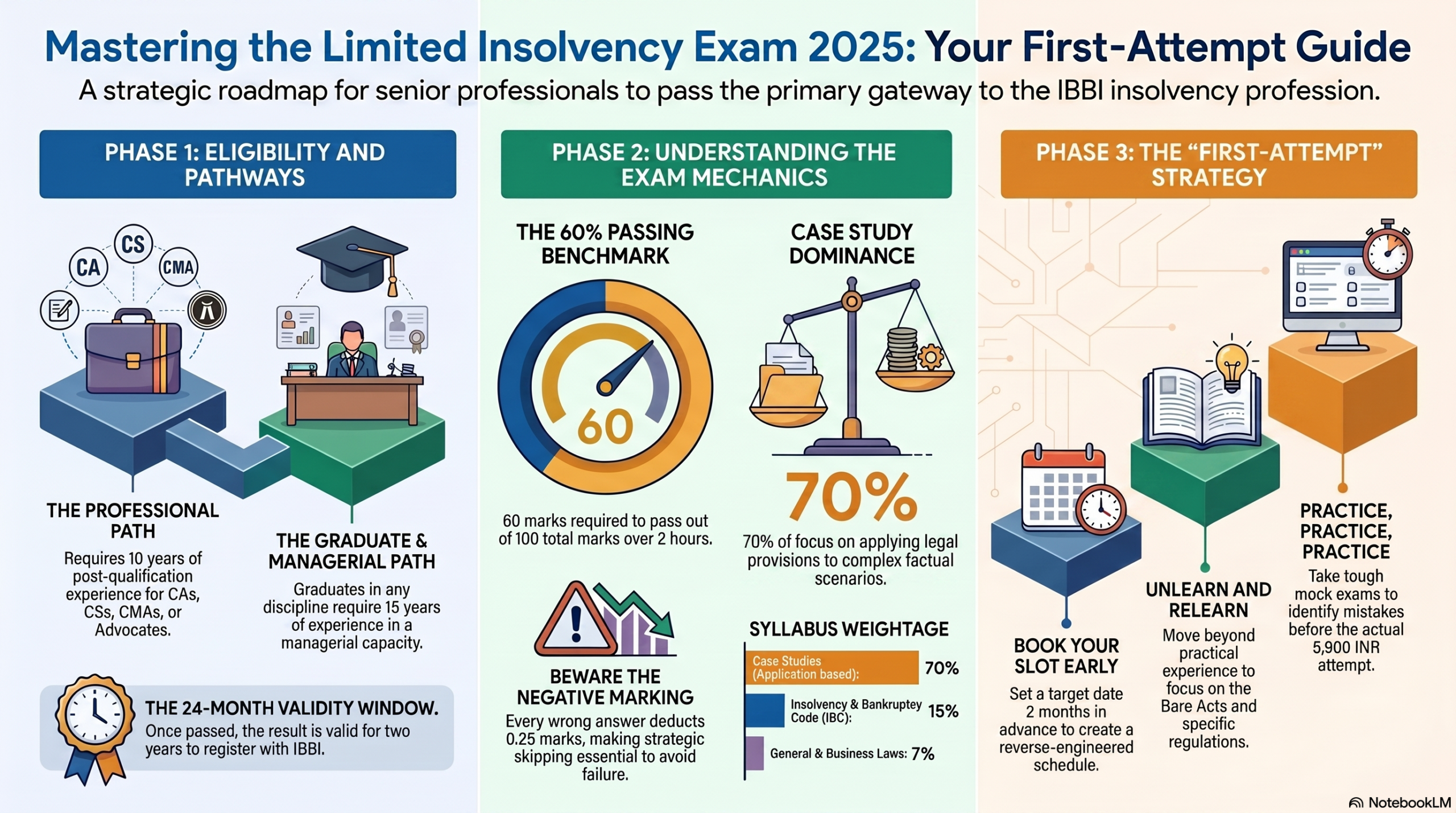
Eligibility for Chartered Accountants (CAs) To qualify for the Limited Insolvency Exam, a CA must possess 10 years of experience. Unlike regular graduates who strictly require managerial experience, a CA’s 10 years of experience can be in any field, whether in practice or in employment. If you do not have 10 years of CA membership but have a total of 15 years of managerial experience overall (combining pre-qualification and post-qualification), you may also qualify under the graduate route,,.
Career Opportunities and Earning Potential Passing the exam opens the door to becoming an Insolvency Professional (IP), allowing you to act as a Resolution Professional, Liquidator, or Bankruptcy Trustee.
- In Practice: CAs setting up their own IP practice can charge Rs. 50,000 to Rs. 1.5 Lakhs (or more) per assignment, with no defined upper limit. However, note that if you are 70 years of age or older, you cannot apply for an Authorization for Assignment (AFA) and are therefore restricted to job roles only.
- In Jobs: If you prefer employment, you can work with advisory firms, law firms, banks, or Insolvency Professional Entities (IPEs). The average salary is between Rs. 15 to 16 Lakhs Per Annum (LPA), with highest packages reaching up to Rs. 34 LPA,. Because the IP concept is heavily utilized abroad, there are also numerous overseas opportunities,.
Exam Structure & Logistics
- Format: It is a 2-hour, online, multiple-choice exam consisting of 65 questions,.
- Scoring: The exam is out of 100 marks, broken down into 30 questions worth 1 mark each and 35 questions worth 2 marks each,.
- Passing Criteria: You need to score exactly 60% to pass,.
- Negative Marking: The exam has a brutal 25% negative marking penalty for every incorrect answer. This means if you get a 2-mark question wrong, you lose the 2 marks plus an additional 0.5 marks,,.
- Fees & Retakes: The exam costs Rs. 5,000 plus GST per attempt,,. You can take the exam multiple times, though there is a cooling-off period after a failure, which is noted as between 21 days and two months before you can reattempt,.
Syllabus & Weightage (Cut-off Date: 4th February 2025) The exam strictly tests the law as amended up to 4th February 2025.
- Case Studies (70% Weightage): The vast majority of the exam focuses on application-based case studies (70 marks) rather than mere theory,,. For example, CIRP and Liquidation case studies alone account for 40 marks.
- Allied Laws: You must study 25 allied laws, which encompass various business and general laws, including new additions like the Mediation Act 2023 and Data Protection laws,.
- Case Laws: You are required to study 72 specific case laws (including 41 Supreme Court judgments), though these surprisingly carry only a 5% weightage in the exam,.
Post-Exam Requirements
- Validity: Once you pass, your result is valid for 24 months (2 years), giving you time to complete the remaining requirements,.
- Pre-Registration Course: Before you can officially register with the Insolvency and Bankruptcy Board of India (IBBI), you must complete a mandatory 50-hour Pre-Registration Educational Course (PREC) through an Insolvency Professional Agency, which costs around Rs. 15,000 plus GST,.
As a Chartered Accountant in practice, you already possess a deep understanding of finance, business laws, and compliance. But if you are planning to take the Limited Insolvency Exam to register as an Insolvency Professional, here is a harsh reality check: your CA qualification alone will not guarantee a passing score.
A major pitfall for many professionals is thinking, “I am a chartered accountant, I can pass in the first attempt”—but without the right strategy, that simply is not going to happen. Even if you have been actively working in the IBC ecosystem for years, you cannot rely on just your practical knowledge to pass.
The Limited Insolvency Exam is a completely different beast, testing your exact application of the law rather than practical workarounds. To clear this exam on your first try while juggling your busy CA practice, you need a targeted strategy. Here is what you need to know, and how the Prokhata.com Question Bank can help you secure your certification.
The Ultimate “Pass-in-First-Attempt” Strategy for Practicing CAs
1. Unlearn to Relearn As a practicing CA, your biggest hurdle is your own experience. You must actively unlearn what you have learned practically in the field, and relearn the exact code and regulations specifically from an exam point of view.
2. Stop Trying to Score 100% You are used to aiming for high scores, but greed will fail you in this exam. Because of the negative marking, guessing is dangerous. Your target should be exactly 60 marks safely. It is perfectly fine—and even recommended—to leave 10 to 15 questions completely blank if you do not know the answers.
3. Do Not Ignore the “Easy” Laws Many professionals skip the Business and General Laws section to focus on complex IBC case laws, but this is a strategic error. These topics are highly theoretical, lack confusing case laws, and are easy scoring opportunities that can push you over the passing line.
4. Protect Your Time Balancing a professional CA practice with exam prep is hard. You must make dedicated time—around three to five hours daily—for a consistent period of two months. If you start preparing and leave it halfway due to client commitments, you will forget everything.
5. Test Your Strategy Before You Finish Studying Do not wait until you have read all 3,000 pages of the bare acts. Once you have simply glanced over the syllabus, take a practice mock exam. You might only score 20%, but it immediately wires your brain to understand the tricky way the examiners frame their questions, allowing you to study smarter.
Why Practicing CAs Need the Prokhata.com Question Bank
Here is the most frustrating part of the actual IBBI exam: if you fail, the institute does not tell you which questions you got wrong or provide you with the correct answers. You are left completely blind.
Your time as a practicing CA is too valuable to waste on multiple attempts. The only way to guarantee a first-attempt pass is by saying the ultimate mantra: “Practice, Practice, Practice”.
This is where the Prokhata Question Bank becomes your greatest asset:
- Review Your Mistakes: Unlike the real exam, our mock tests allow you to thoroughly review your answers and see exactly what the right answers are, bridging your knowledge gaps instantly.
- Higher Difficulty for Better Readiness: Our mock exams are designed to be intentionally tougher than the actual IBBI test. If you can score just 55% on our platform, you will confidently score 62% to 65% in the real exam.
- Cure the “Guessing” Habit: Prokhata’s simulation will train you to leave questions blank, helping you master the art of avoiding the 25% negative marking penalty.
Don’t let your practical experience give you a false sense of security. Head over to Prokhata.com today, invest in our Limited Insolvency Exam Question Bank, and walk into the exam hall with the ultimate, foolproof strategy.
0 responses on "How CAs Can Pass the Limited Insolvency Exam in the First Attempt"